Dog Training Tips for Beginners: Proven Methods That Work in 2026
Dog Training Tips for Beginners: Proven Methods That Work in 2026
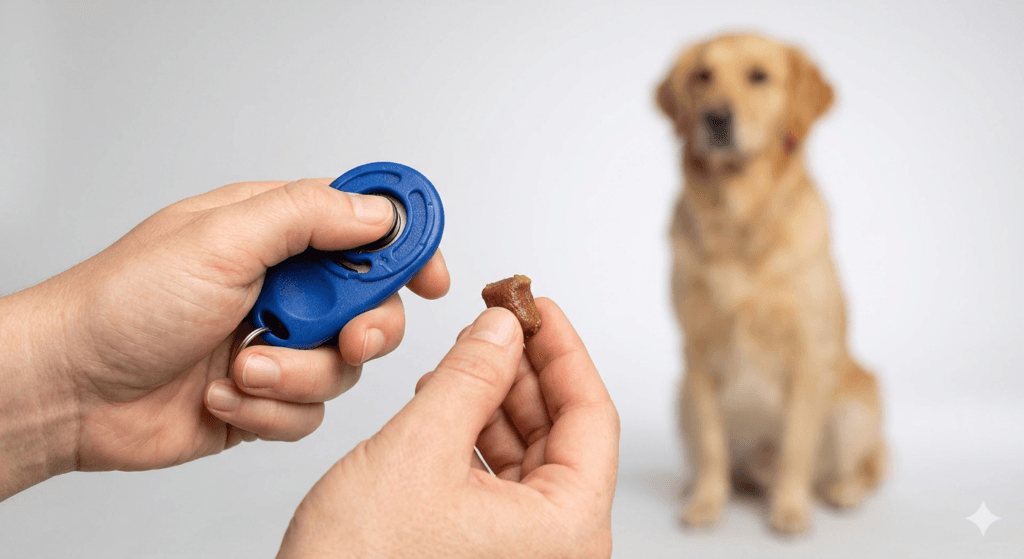
Table of Contents
Quick heads up: This guide covers general training advice for healthy adult dogs and puppies. Every dog is different, and some behavioral issues need a certified professional trainer or vet behaviorist. If your dog shows aggression or extreme anxiety, please seek in-person help first.
So you’ve got a dog. Maybe a bouncy eight-week-old puppy who’s already chewed through one shoe, or a rescue adult who just stares at you with that look that says absolutely nothing you’re doing is making sense. Either way, you’re in the right place. Dog training tips for beginners can feel completely overwhelming when you first start looking, because honestly, there’s a lot of noise out there.
But here’s the thing though: training your dog doesn’t require a professional certificate or a garage full of equipment. It requires consistency, patience, and knowing which handful of principles actually work.
This is the part most guides skip over. They throw 40 tips at you and call it a day. We’re going to do this differently.
In this guide you’ll find out:
- Why timing is the single biggest factor new owners get wrong — and what dog training tips for beginners actually fix it
- The five commands every dog genuinely needs to learn first
- How to handle common problem behaviors without losing your mind
- Which training tools are actually worth your money (and which aren’t)
- A week-by-week starter schedule you can use right now
Why Dog Training Tips for Beginners Start With Your Mindset, Not Your Dog
Most people assume training fails because of the dog. The dog is stubborn. The dog is distracted. The dog just won’t listen. But any honest set of dog training tips for beginners will tell you the same thing: the dog is rarely the real problem.
Your dog doesn’t speak English. They can’t follow a logic chain. What they can do, really well, is read patterns and connect actions to outcomes. That’s the whole game.
And that’s actually the point of training: you’re teaching your dog that certain behaviors reliably produce good outcomes. Not punishing the bad ones into disappearing.
The Timing Rule That Changes Everything
Of all the dog training tips for beginners you’ll come across, this one gets skipped the most. The reward window for a dog is about 1 to 2 seconds after the behavior happens. Not five seconds. Not “in a moment.” One to two seconds. If your dog sits and you spend three seconds reaching for a treat, the connection is already starting to blur in their brain.
This is why clicker training became popular, by the way. The click marks the exact moment the right behavior happens, so even if the treat takes a second longer to arrive, the dog knows exactly what they did right. A lot of beginners skip this tool. Which, honestly, is a mistake.
Positive Reinforcement Isn’t Just Being Nice
There’s a counterintuitive truth here that goes against what a lot of people were taught. Punishment-based training can get fast results on the surface, but it often creates anxiety and avoidance behaviors that make things way harder down the road. Studies from veterinary behaviorists, including research cited by the American Kennel Club, consistently show that reward-based methods produce more reliable long-term behavior.
It’s not soft. It’s not spoiling your dog. It’s just the more effective approach.
The 5 Commands to Teach First (In This Order)
A lot of owners make the mistake of jumping straight to flashy tricks or off-leash recall before the fundamentals are solid. That’s building a house with no foundation. Any solid set of dog training tips for beginners will tell you the same thing: start with the basics.
Start with these five. In roughly this order. Don’t rush to the next one until the current one is reliable in at least three different environments, not just your living room.
Sit
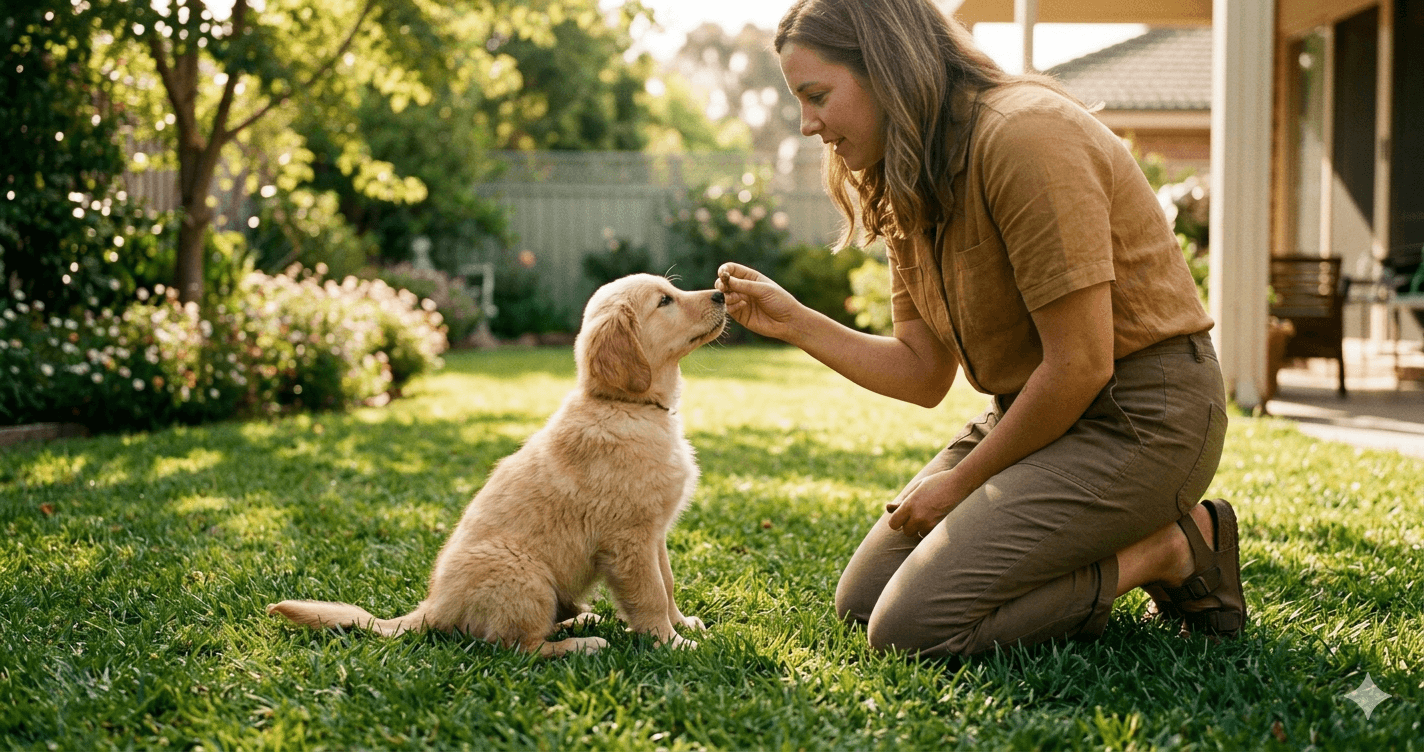
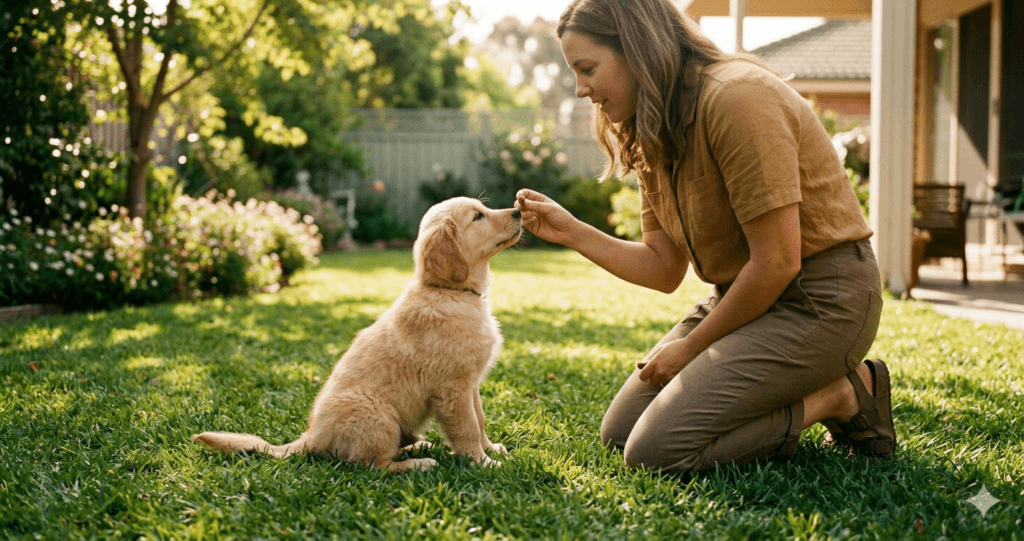
The classic for a reason. “Sit” is easy to teach, fast to proof, and endlessly useful. Hold a treat at your dog’s nose, then slowly move it back over their head. Their bottom will hit the floor almost automatically. The moment it does, click or say “yes” and reward. Repeat about 10 times per session, two or three sessions a day, and most dogs have a solid sit within a week.
Stay
This one takes longer. Don’t try to get a 30-second stay on day one. Ask for a sit, wait one second, reward. Then two seconds. Then five. Build duration before you build distance. A lot of beginners do it backwards and get frustrated when the dog keeps breaking.
Come (Recall)
Arguably the most important command for safety. Never call your dog to you and then immediately do something unpleasant (like ending playtime or giving a bath). You’ll poison the recall cue fast. Always make coming to you the best possible outcome, every single time.
Leave It
Underrated. Wildly underrated. Whether it’s a chicken bone on the sidewalk or your kid’s sock, “leave it” could literally save your dog’s life one day. Teach it early.
Down
Harder than sit because dogs feel more vulnerable lying down, especially in a new place. Don’t force it. Lure slowly. Some dogs need a few extra days on this one and that’s completely fine.
Common Problem Behaviors and What to Actually Do About Them
So your dog is doing something you’d rather they didn’t. Welcome to dog ownership.
Here’s the honest reality: most problem behaviors are either boredom, anxiety, or a behavior that worked and got reinforced without you realizing it. The best dog training tips for beginners always circle back to the same thing — consistency beats intensity, every single time. The fix is almost never yelling at the dog.
Jumping Up on People
Your dog jumps because jumping worked. Someone squealed and gave them attention. This is one of those behavior fixes that dog training tips for beginners cover early — for good reason. The fix: completely ignore jumping (turn away, cross your arms, zero eye contact) and reward all four paws on the floor. Sounds simple. Takes longer than you’d expect, because guests won’t follow the rules. If your dog is anything like mine, they’ve already figured out which visitors are pushovers.
Pulling on the Leash
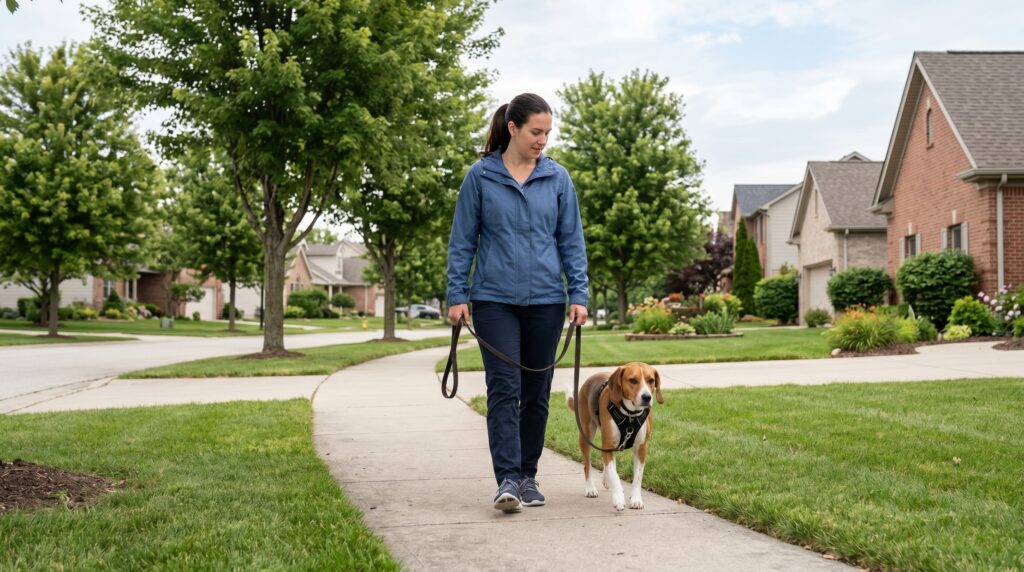
Stop walking the second tension hits the leash. Just stop. Wait. The moment there’s slack, walk forward again. This takes patience, especially in the first week when your walks are barely making it to the end of the driveway. But it works. Most dogs click onto this within 10 to 14 days of consistent practice.
Excessive Barking
First figure out why. Alert barking at strangers, demand barking for food, boredom barking at 2am, anxiety barking when you leave, these all have different solutions. Treating them all the same is how people spend years “working on the barking” with zero progress.
Take a look at how these common behaviors compare in terms of difficulty and timeline:
| Behavior | Root Cause | Avg. Time to Improve | Success Rate With Consistency |
|---|---|---|---|
| Jumping up | Attention-seeking | 2-4 weeks | High |
| Leash pulling | Unreinforced habit | 10-14 days | High |
| Alert barking | Instinct/territorial | 4-8 weeks | Moderate |
| Demand barking | Learned behavior | 1-3 weeks | High |
| Separation anxiety | Fear/panic response | 3-6 months | Moderate (needs structure) |
| Resource guarding | Instinct/insecurity | Varies | Consult a professional |
Training Tools Worth Knowing About in 2026
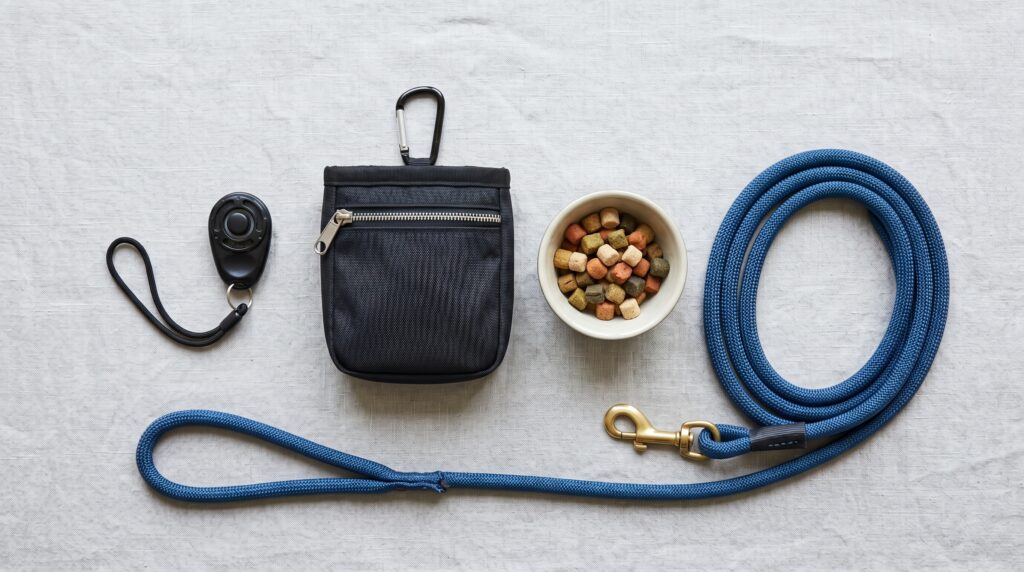
You don’t need a lot of gear. But a few tools will make this process significantly faster, and a few others are genuinely worth skipping. These are the ones that come up in every reliable list of dog training tips for beginners.
- Clicker: $3 to $8 and probably the highest-value training tool per dollar you’ll buy
- High-value treats: Small, soft, and smelly, think real chicken or cheese for early training sessions, not the dry biscuits at the bottom of every gift basket
- Long line (15-20ft leash): Essential for recall training in open spaces before your dog is ready to go off-leash
- Treat pouch: Keeps your hands free and rewards fast, which ties back to that 1-2 second timing window
- Front-clip harness: For leash pullers, reduces pulling immediately without any aversive pressure on the throat
Things you probably don’t need yet: shock collars, prong collars, spray bottles, or anything that requires your dog to be afraid of you to work. Not great.
A Note on Training Classes
One thing most dog training tips for beginners don’t mention: group obedience classes run around $100 to $200 for a 6-week session at most pet stores and local training facilities. Worth it, especially for puppies, because socialization with other dogs in a controlled environment is hard to replicate at home. But a class can’t replace your daily at-home practice. It’s more like a weekly check-in than the actual training itself.
Your First-Week Dog Training Schedule (Beginner-Friendly)
Whether you’ve had dogs for years or just got your first puppy last Tuesday, a simple structure makes everything feel less chaotic. This is where most dog training tips for beginners actually start to click — not when you read about them, but when you put them on a schedule.
Stick with me here, because this is where people often overcomplicate things. Your dog doesn’t need two-hour training marathons. They need short, frequent, positive sessions. Five minutes, three times a day, beats thirty minutes once a day. Every time.
| Day | Morning (5 min) | Afternoon (5 min) | Evening (5 min) |
|---|---|---|---|
| Day 1-2 | Sit intro | Sit practice | Sit + name response |
| Day 3-4 | Sit review | Stay intro (1-2 sec) | Sit + Stay combo |
| Day 5-6 | Stay duration | Come intro (short distance) | Sit + Stay + Come |
| Day 7 | Review all three | Leave it intro | Free play + leash practice |
End every session while things are still going well. Before your dog gets bored or frustrated. That rule alone separates the dog training tips for beginners that actually work from the ones that don’t. This keeps training a positive experience and means your dog will actually be excited to do it again tomorrow.
Your dog is counting on you to get this right, and the good news is that you don’t have to be perfect. You just have to be consistent. And if you ever notice something feels off beyond behavior, it’s worth knowing the warning signs — our guide on recognizing when your pet is sick walks through the subtle signals most owners miss.
Frequently Asked Questions
How long does it take to train a dog from scratch?
When you apply dog training tips for beginners consistently, basic commands like sit, stay, and come can be reliably learned within 2 to 4 weeks of daily practice. Real-world proofing, meaning your dog listens at the dog park, not just in your kitchen, usually takes another 2 to 3 months. Full off-leash reliability in distraction-heavy environments can take 6 months to a year. The timeline varies a lot by breed, age, and how consistent you are with training.
What age should you start training a puppy?
As early as 7 to 8 weeks old. Puppies are absorbing everything at that age. Short 3-minute sessions focused on sit, name recognition, and gentle handling are completely appropriate. Waiting until 6 months is one of the most common mistakes new owners make, because you’ve missed the peak socialization and learning window.
Can you train an older or rescue dog?
Absolutely yes. The “you can’t teach an old dog new tricks” thing is just not true. These dog training tips for beginners work just as well for adult and rescue dogs — they often have better focus than puppies and can learn quickly. The main difference is that a rescue dog may come with existing habits or fears that need more patience and sometimes professional guidance to work through. And if you’re also figuring out their diet, our guide to the best dog food for small breeds is a good place to start.
How many treats should I use during training?
Lots, especially early on. This is one of those dog training tips for beginners that feels counterintuitive at first. Don’t worry about overdoing it in the beginning, that’s how the behavior gets established. As your dog gets more reliable, you fade the treats gradually, rewarding every third or fourth correct response instead of every one. This actually makes the behavior more durable long-term, because your dog learns they can’t predict exactly when the reward comes.
My dog knows the commands at home but ignores me outside. What’s wrong?
Nothing is wrong, and this doesn’t mean your dog training tips for beginners aren’t working. This is called generalization, and it’s a normal part of learning. Your dog learned “sit” in the kitchen, not in the world. You have to proof each command in progressively more distracting environments, starting somewhere only slightly more distracting than home. A quiet backyard, then a quiet street, then a park with one other dog. Take it in steps and don’t skip levels.
Ready to keep learning? If your pet is acting off and you’re not sure whether it’s stress or something physical, check out our guide on signs your cat is sick — understanding animal behavior and health signals go hand in hand, whether you have a cat or a dog. And for more expert-backed training science, AKC’s training resource center is one of the best free libraries out there.
Dog training tips for beginners can feel like a lot to take in at once. So start small. Pick one command. Practice it for one week. And then build from there. That’s it. That’s the whole secret.